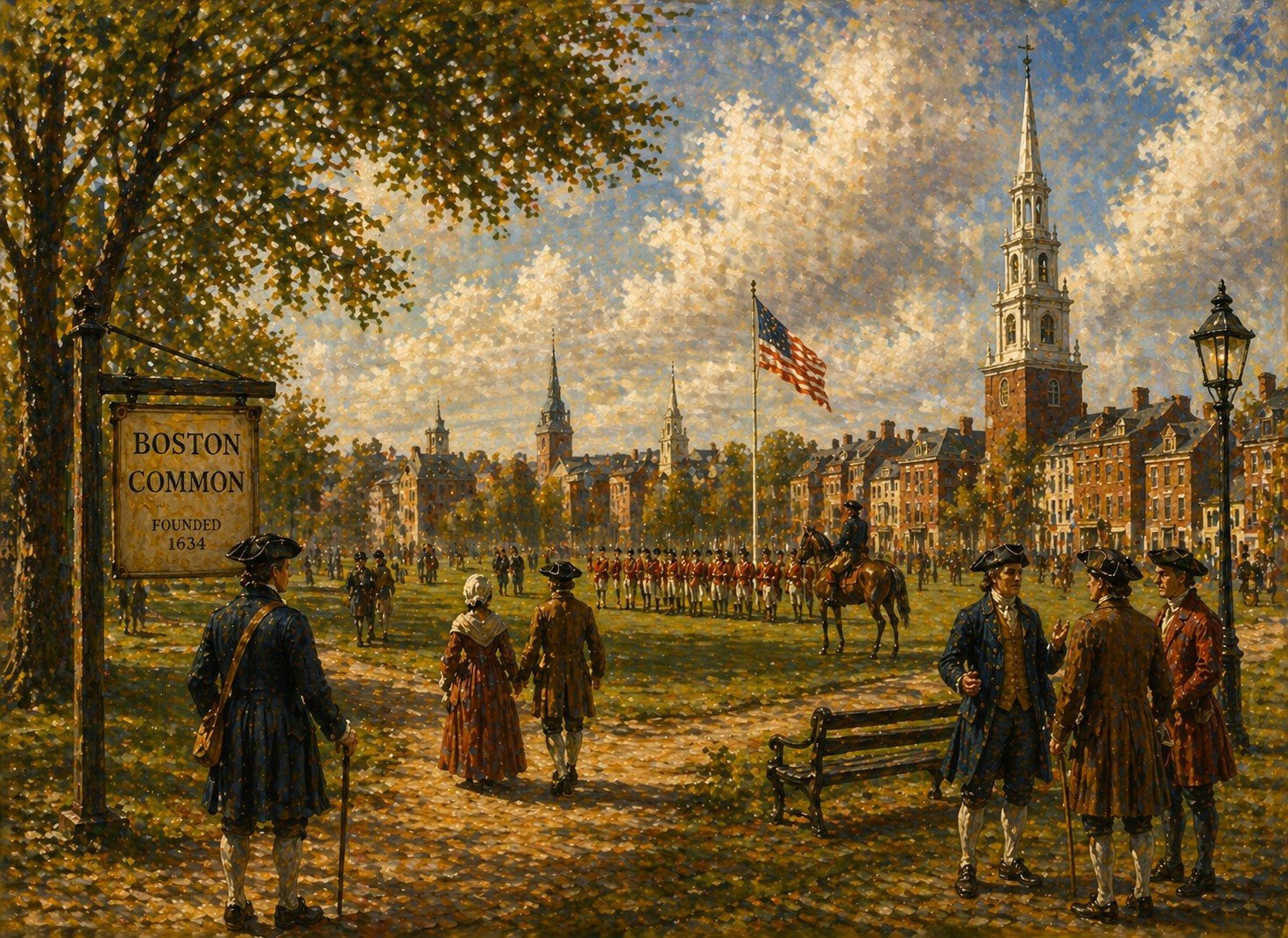
Park Street Church, built in 1809, is one of the most recognizable landmarks along the Freedom Trail. Located at the eastern edge of Boston Common, its tall white steeple rises prominently above the surrounding area, making it a visual and historical focal point in the heart of Boston. While it was constructed after the American Revolution, its role in shaping social, religious, and reform movements makes it an essential stop on the trail.
Park Street Church was designed in the Federal style, reflecting the architectural trends of the early 19th century. Its elegant simplicity and towering spire, reaching over 200 feet, made it one of the tallest structures in Boston at the time. For sailors approaching the city, the steeple served as a landmark, visible from the harbor and symbolizing the city’s identity. The building’s location at a busy intersection further ensured its prominence in daily life.
The nickname “Brimstone Corner” emerged from the church’s reputation for fiery preaching. Ministers associated with Park Street Church were known for delivering sermons that emphasized moral accountability, sin, and divine judgment. This intense and uncompromising style of preaching earned the corner its dramatic name, reflecting both the tone of the sermons and the strong religious convictions of the congregation. In an era when religion played a central role in public life, such preaching could influence not only personal behavior but also broader social attitudes.
Beyond its religious significance, Park Street Church became an important center for reform movements in the 19th century. It was closely associated with the abolitionist cause, providing a platform for anti-slavery speakers and discussions. At a time when the issue of slavery was deeply divisive, the church’s willingness to host such voices placed it at the forefront of social change. This connection to abolitionism links the site to the ongoing struggle for freedom and equality that extended beyond the revolutionary period.
The church is also notable for its connection to American cultural history. In 1831, the patriotic hymn “My Country, ’Tis of Thee” was first sung publicly here, adding another layer to its significance. This event highlights how Park Street Church served not only as a place of worship but also as a venue for expressions of national identity and unity.
As part of the Freedom Trail, Park Street Church represents the evolution of American ideals in the decades following independence. Whilst earlier stops along the trail focus on the fight for political freedom, this site reflects the continued effort to define and expand those freedoms within society. The church’s involvement in movements such as abolition demonstrates how the principles of liberty and justice were debated and reinterpreted over time.
The interior of Park Street Church retains much of its historic character, with traditional wooden pews, a central pulpit, and a layout designed to focus attention on preaching. This design reflects the priorities of the congregation, emphasizing the importance of the spoken word in religious and social life. Visitors who step inside can gain a sense of the atmosphere that gave rise to the church’s reputation and influence.
Its location at the junction of Park and Tremont Streets places it at a key transition point along the Freedom Trail. Visitors moving from Boston Common toward the Granary Burying Ground encounter the church as both a physical landmark and a thematic bridge. It connects the revolutionary history of the 18th century with the reform movements of the 19th century, illustrating how the quest for freedom continued in new forms.
Today, Park Street Church remains an active place of worship while also serving as a historic site. Its dual role reflects the broader character of the Freedom Trail, where many locations are not simply preserved relics but living spaces that continue to function within the modern city. This continuity adds depth to the visitor experience, showing that history is not confined to the past but remains part of the present.
Ultimately, Park Street Church stands as a powerful reminder that the story of American freedom did not end with independence. Through its preaching, activism, and cultural contributions, it helped shape the moral and social direction of the nation. As “Brimstone Corner,” it represents both the intensity of conviction and the ongoing struggle to align society with its highest ideals, making it a vital and compelling stop on the Freedom Trail.